In this article:
- What Is Zone 0, and Why Bay Area Homeowners Are Talking About It Now
- Is the Zone 0 Rule Actually Law Yet?
- Which Bay Area Cities Are in a Very High Fire Hazard Severity Zone
- What CAL FIRE Recommends You Clear From the First 5 Feet
- The Problem Nobody Tells You About Zone 0 Cleanup
- Zone 0 vs. Defensible Space Zones 1 and 2
- Where a Dumpster Makes Sense for Zone 0 Cleanup (and When It Doesn’t)
- Does Clearing Zone 0 Affect Your Homeowners Insurance?
- A Contra Costa Zone 0 Cleanup, Start to Finish
- Zone 0 Wildfire Debris Removal FAQ
- Is Zone 0 the same thing as defensible space?
- Do I have to comply with Zone 0 if my home isn’t in a Very High Fire Hazard Severity Zone?
- How often do I need to redo Zone 0 clearing?
- Why does the first five feet matter more than the rest of the yard?
- What affects the scope of a Zone 0 wildfire debris removal project?
- What should I ask before renting a dumpster for Zone 0 cleanup?
- Is the California Zone 0 rule already in effect?
Direct Answer: Zone 0 wildfire debris removal means clearing combustible material, dead vegetation, mulch, and firewood from the five feet closest to your home, the ember-resistant zone that CAL FIRE and California’s Board of Forestry recommend Bay Area homeowners in high fire-risk areas clear now.

What Is Zone 0, and Why Bay Area Homeowners Are Talking About It Now
Zone 0 is the five feet of ground closest to your house, deck, or any attached structure, and it is the single most important stretch of your property for stopping ember-driven wildfire spread. Fire scientists call it the ember-resistant zone, insurers call it the immediate zone, and your neighbor probably just calls it “the strip next to the house.” All three describe the same five feet.
You have likely heard the term more this month than at any point in the last few years. On August 19, 2026, the California Board of Forestry and Fire Protection voted unanimously to approve the final draft of the state’s first-in-the-nation Zone 0 regulation. It is a milestone, not a finish line, and that distinction changes how you should plan your cleanup right now.
This guide covers three things: what CAL FIRE and the new state rule actually recommend you clear, which Bay Area cities carry the highest fire hazard designation, and how a roll-off dumpster fits into the cleanup once you get past the first few bags of yard debris. If you want to talk through your property before you start, reach out to our team and we can help you size the job.
Is the Zone 0 Rule Actually Law Yet?
Not yet, and that matters if you are timing your Zone 0 wildfire debris removal around a hard deadline. The Board of Forestry’s vote approved the final draft regulation text. Before it becomes enforceable, the package still has to clear the Office of Administrative Law and a public comment window, then get published by the Secretary of State.
The vote settles what the rule will require. It does not yet settle exactly when your specific address has to comply. Once the regulation is published, implementation phases in over roughly five years, with the first phase focused on removing combustible material, cleaning gutters, and trimming trees around existing homes. Newly built homes will need to comply as soon as the rule takes effect, without the phased runway given to existing properties.
State officials have said the early years will lean on education and outreach rather than fines. That is a reasonable posture for a brand new statewide rule, but it is not a reason to wait. The underlying wildfire risk that Zone 0 addresses has not changed just because the paperwork is still moving through Sacramento.
Which Bay Area Cities Are in a Very High Fire Hazard Severity Zone
Once the regulation takes effect, it will apply to homes in State Responsibility Areas and to homes in Very High Fire Hazard Severity Zones inside Local Responsibility Areas. In Contra Costa County, the state fire marshal’s updated maps place parts of twelve cities in the very high category: Concord, Danville, Orinda, Lafayette, Moraga, Clayton, El Cerrito, Richmond, San Pablo, Pinole, Antioch, and Brentwood.
If you live in the hills above Danville or along the ridgelines near Orinda and Moraga, this is not an abstract policy discussion. It is the yard you look at every morning. Alameda County has its own hillside communities, including parts of Oakland, Berkeley, and Fremont, with their own fire hazard designations on the state’s maps.
Your exact designation depends on your parcel, not just your city, so confirm your address against the state’s Fire Hazard Severity Zone viewer before assuming either way. A home two streets apart from a very high zone can fall just outside it.
What CAL FIRE Recommends You Clear From the First 5 Feet

CAL FIRE and the new state standard focus on a short list of combustible materials that tend to collect right where they can do the most damage. Here is what typically needs to come out during a Zone 0 wildfire debris removal project, along with the mistake we see most often on each one.
- Bark mulch and wood chips: swap for hardscape like gravel, pavers, or brick within the foot or two closest to the walls. The common mistake is leaving “just a little” bark mulch against the foundation because it looked tidy last season.
- Dead and dying vegetation: any shrub that has browned out, dropped most of its leaves, or stopped putting out new growth. The common mistake is judging a plant by its base, when the dead material higher up the branches is what actually carries an ember.
- Firewood and lumber stacks: relocate these well outside Zone 0, ideally 30 feet or more from the structure. The common mistake is stacking wood against a side wall for easy winter access.
- Roof and gutter debris: dry leaves, pine needles, and seed pods that collect after wind events. The common mistake is skipping a gutter check because the roof looks clear from the ground, when the gutters themselves are full.
- Combustible fencing near the structure: existing fences can often stay in place under the current draft, but new construction directly against the house will need a noncombustible section where it attaches. The common mistake is adding a new wood gate flush against a wall to close off a side yard.
The Problem Nobody Tells You About Zone 0 Cleanup
A yard that looks reasonably tidy from the driveway almost always hides more debris volume than homeowners expect once they start pulling dead shrubs and clearing years of accumulated mulch. Dried vegetation and matted mulch are bulkier and heavier than fresh green waste, and a dead root ball takes up far more room in a truck bed than its weight would suggest.
Mixed loads make it worse. Branches, old mulch, and a section of removed fencing do not compact the way loose trash does, so a single truck bed fills up faster than most people plan for.
- Cut larger shrubs and branches into shorter sections before hauling, so they load flat instead of leaving gaps.
- Separate green waste from wood and fencing material if your hauler requires a clean load.
- Stage debris in one spot before pickup day instead of pulling it piecemeal.
- Measure your longest branches against your container’s opening before you start cutting.
Before you commit to a truck bed and several dump runs, ask yourself a practical question: how many total trips would clearing your entire house, not just the one wall you can see from the street, actually take?
Zone 0 vs. Defensible Space Zones 1 and 2
Zone 0 gets the strictest standard because it sits closest to the structure, but California’s defensible space rules cover the full 100 feet around a home. Here is how the three zones compare.
| Zone | Distance from structure | Primary focus | Typical debris generated |
|---|---|---|---|
| Zone 0 | 0 to 5 feet | Noncombustible or hardscaped ember-resistant buffer | Mulch, dead plants, firewood, roof and gutter debris |
| Zone 1 | 5 to 30 feet | Lean, clean, and spaced vegetation | Cut branches, thinned shrubs, pruned tree limbs |
| Zone 2 | 30 to 100 feet | Reduced fuel load, managed grass and spacing | Mowed grass, cut brush, larger tree prunings |

Homeowners often assume that clearing Zone 1 and Zone 2, the more visible parts of a yard, covers the requirement. In practice, the five feet closest to the house carries the strictest rules precisely because it is the zone most people overlook.
Where a Dumpster Makes Sense for Zone 0 Cleanup (and When It Doesn’t)

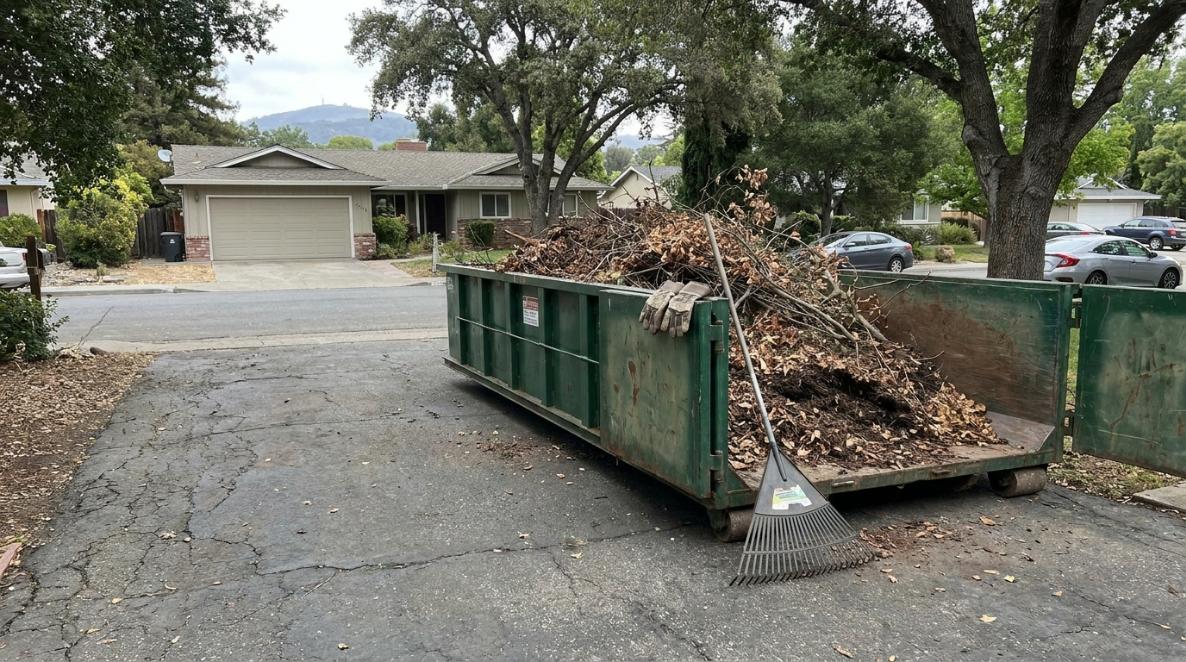
A half-acre lot in the Danville hills with overgrown junipers pressed against the foundation and an old stack of fence sections in Zone 0 is a textbook case for a roll-off container. So is a Lafayette property clearing several fire seasons’ worth of accumulated mulch and dead landscaping in one pass. In both cases, the debris volume is large enough, and mixed enough, that hauling it out bag by bag stretches into weeks.
A dumpster makes less sense for a small touch-up, like clearing a single bed of mulch along one wall of a townhome. A municipal green waste bin or a scheduled yard-waste collection day usually handles that faster than arranging delivery and pickup of a container.
Bagging debris for curbside pickup means waiting for the next scheduled collection day, and vegetation regrows in the meantime. Renting a container lets you clear the whole zone around your entire home in one weekend instead of spreading the job across several trash days. Feedback on our Yelp profile tends to echo the same theme: homeowners appreciate a crew that shows up on time and helps size the container correctly on the first try, rather than guessing and coming up short mid-project.
If you are not sure which size fits your property, our Contra Costa County service area page breaks down container options across the communities we cover, and our team can help you match capacity to the job.
Does Clearing Zone 0 Affect Your Homeowners Insurance?
It can, through a separate program from the Board of Forestry regulation. California’s Safer from Wildfires framework, run by the Department of Insurance, requires admitted insurers to offer credits for documented mitigation work, including a five-foot ember-resistant zone. Filed discounts vary by carrier, generally five to twenty percent of the wildfire portion of a premium.
These are two different systems. Complying with the state’s defensible space rule does not automatically trigger an insurance discount, and qualifying for a credit does not automatically mean you meet the regulatory standard. If a discount is part of your motivation, ask your carrier about their documentation requirements, usually dated photos, before you finish the project.
A Contra Costa Zone 0 Cleanup, Start to Finish
Consider a hypothetical, fairly typical example. A two-story home in the Danville hills has mature junipers planted flush against the foundation, along with a decade of bark mulch never swapped for hardscape and an old woodpile tucked against the garage wall.
The project started with removing the junipers, hauling out the old mulch, and relocating the firewood well outside Zone 0. A mid-size roll-off container handled the combined volume in one placement, avoiding multiple trips to a transfer station. The homeowner finished over a single weekend and used the same container to start on nearby Zone 1 brush before the rental period ended.
Zone 0 Wildfire Debris Removal FAQ
Is Zone 0 the same thing as defensible space?
No. Zone 0 is one part of defensible space, the strictest part, covering just the first 5 feet around a structure. Defensible space as a whole runs out to 100 feet, through Zone 1 and Zone 2, but Zone 0 carries the tightest rules because it is where embers are most likely to ignite a home.
Do I have to comply with Zone 0 if my home isn’t in a Very High Fire Hazard Severity Zone?
Once in effect, the rule applies to State Responsibility Areas and Very High Fire Hazard Severity Zones. Outside both, the statewide rule likely will not apply directly, though several Bay Area fire districts run their own defensible space inspections on a similar timeline regardless.
How often do I need to redo Zone 0 clearing?
It is not a one-time project. Vegetation regrows and gutters refill every fall, so most fire districts recommend a check before the dry season peaks, with a lighter follow-up after leaf drop. Homes under oaks or pines in Lafayette, Orinda, or Moraga tend to need it more often.
Why does the first five feet matter more than the rest of the yard?
Homes rarely ignite from a wall of flame reaching the structure. They ignite from embers landing in mulch or dead leaves right next to the walls, and the first five feet gives those embers the shortest path in, which is why CAL FIRE treats it as the top priority zone.
What affects the scope of a Zone 0 wildfire debris removal project?
Lot size, how long the property has gone without clearing, and how much of the perimeter is planted versus hardscaped. Tree removal, old fencing, and shed relocation add scope beyond basic mulch removal, so walk your foundation and count linear feet of vegetation before booking a container.
What should I ask before renting a dumpster for Zone 0 cleanup?
Ask whether the company accepts yard debris without extra sorting, since some haulers cap green waste volume. Ask about container sizes so you can match capacity to the project, and confirm placement requirements and rental length if the job spans a full weekend.
Is the California Zone 0 rule already in effect?
Not yet. The Board of Forestry approved the final draft on August 19, 2026, but it still needs Office of Administrative Law review and a public comment period before publication. Existing homes get a phased multi-year timeline once it takes effect, so confirm current status with your local fire department first.

Get Your Zone 0 Cleanup Started
The state rule is still working its way through final approval, but the wildfire risk it addresses is not waiting on paperwork. Whether you are clearing mulch and dead junipers from a hillside lot in Danville or getting ahead of fall gutter debris in Walnut Creek, a Zone 0 wildfire debris removal project is easier to finish in one weekend than to chip away at over several months.
BBP Dumpster serves homeowners throughout Contra Costa County and Alameda County, including the twelve Contra Costa cities carrying a Very High Fire Hazard Severity designation. You can find our Concord location on MapQuest or contact our team directly to talk through your property and get a container sized to your Zone 0 wildfire debris removal project.